How to get the
best story
from your memories
You do not need to prepare a perfect script. You do not need to write beautifully. Just give us the people, memories, photos, feelings, and little details that matter. We’ll shape them into a polished interactive storybook.
Think of this page as a preparation guide, not a rulebook.
The more real details you give us, the more personal the final story can feel.
More useful detail = a more personal story
The best MyHeartfolio stories are built from real details: how someone looked, what they loved, where the memories happened, what made the relationship special, and the small things only you would know.
Your notes do not need to be perfectly organized. They can be rough, emotional, messy, or written like a voice note. What matters is that we have enough material to understand the story.
“Make a romantic story about us.”
“Make a romantic story about me and Sara. We met at a university library in autumn, bonded over bad coffee and late-night walks, moved in together after three years, and she always says ‘one more minute’ before leaving anywhere. I want it to feel warm and emotional, but not too cheesy.”
Start with the basic story context
The first part of the form helps us understand who the story is for, who it comes from, what kind of relationship it represents, and what the occasion is.
These details may look simple, but they help us write with the right emotional direction from the beginning.
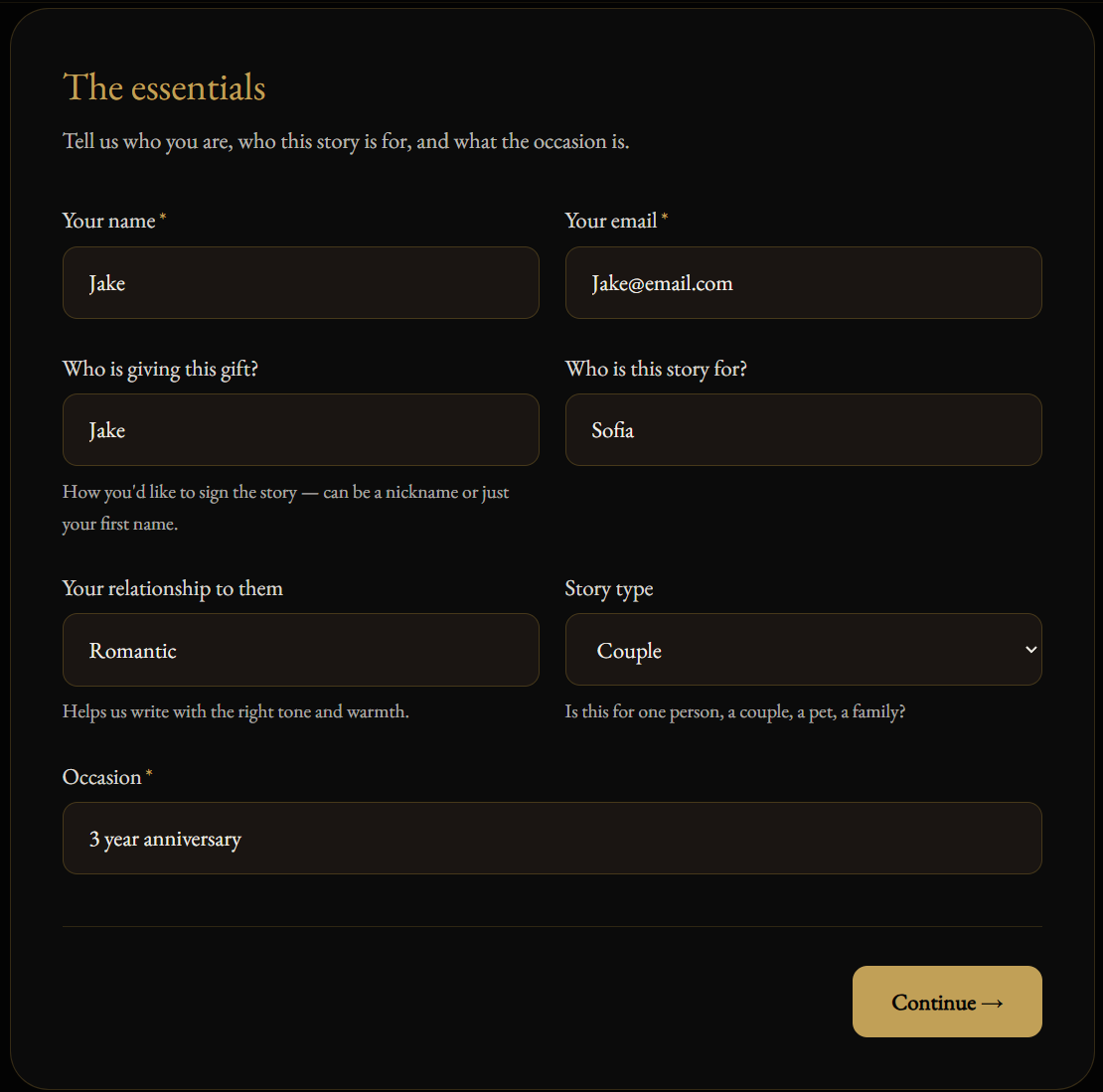
A simple example of the basic information that gives the story its starting context.
Three ways we can handle visuals
Use your real photos as they are
Choose this if you want the story to use your original photos without turning them into illustrations, cartoons, or stylized images.
- Memorials
- Family keepsakes
- Real-life photo albums
- Stories where authenticity matters most
“Please use my real photos as they are. Do not cartoonize, stylize, or modify the people.”
Turn your photos into a consistent illustrated style
Choose this if you want the story to feel like a polished digital storybook while still being based on real people, pets, or places.
- Romantic stories
- Birthday stories
- Family stories
- Magical or cinematic storybooks
“I uploaded reference photos of us. Please use them to create consistent illustrated versions of us throughout the story.”
Create visuals from description only
Choose this if you do not have photos, do not want to upload photos, or want the story to be more symbolic or fictionalized.
- Surprise gifts
- Stories without many photos
- Fantasy-style stories
- Symbolic memory pieces
“I do not have photos. Please create the visuals from my descriptions. He has short brown hair, wears glasses, usually dresses casually, and the story should feel cozy and nostalgic.”
Good reference material helps us keep the story consistent
If the story includes real people or pets, photos are the best reference we can have. They help us understand appearance, age, personality, expressions, clothing style, and the feeling of the relationship.
If the story follows someone across many years, try to include photos from different stages of life.
You can also upload already-created cartoon or illustrated versions of yourself, your pet, or your characters. If you want us to use those as the visual reference, just mention it in the photo notes.
For a life story or family story
Helpful references could include:
- Childhood photo
- Teenage or young adult photo
- Recent photo
- Important places
- Family or group photos
- Favorite objects, pets, or meaningful items
For a pet memorial
Helpful references could include:
- Puppy, kitten, or early photo
- Favorite sleeping pose
- Playful photo
- Family photo together
- Final older photo, if appropriate
- Favorite toy, blanket, garden, or walking place
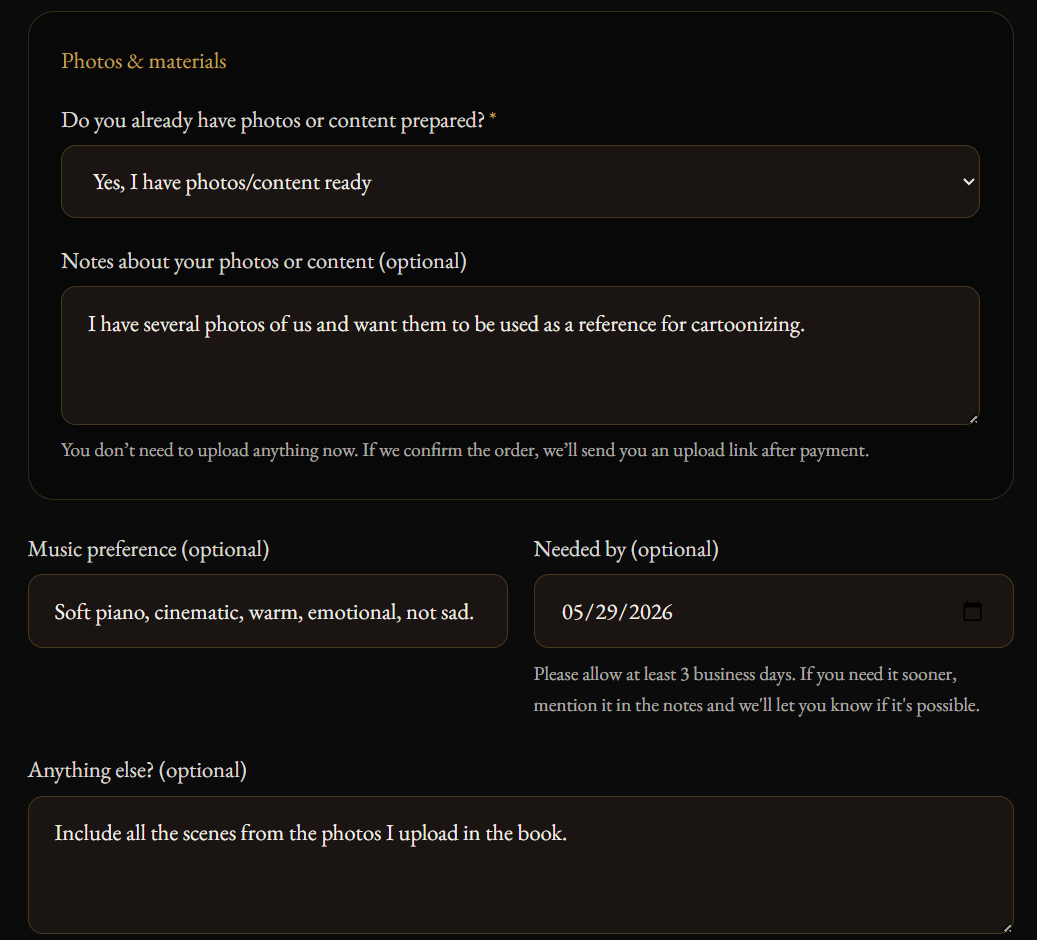
Photo notes help us understand whether your images should be used directly, treated as references, or used as inspiration for illustrated visuals.
What should I write in the story idea?
Add as much detail as you can. It helps us create a more accurate, personal, and meaningful result.
The story idea is the most important part of the form. This is where you tell us what the story is really about.
Try to include who the story is about, who it is for, the occasion, the emotion you want to create, important memories, inside jokes, special phrases, and anything that should be avoided.
- Who the story is about
- Who it is for
- What the occasion is
- What kind of emotion it should create
- The most important memories
- Inside jokes, phrases, or special details
- Whether you want it funny, emotional, romantic, magical, nostalgic, or simple
- Anything that should be avoided
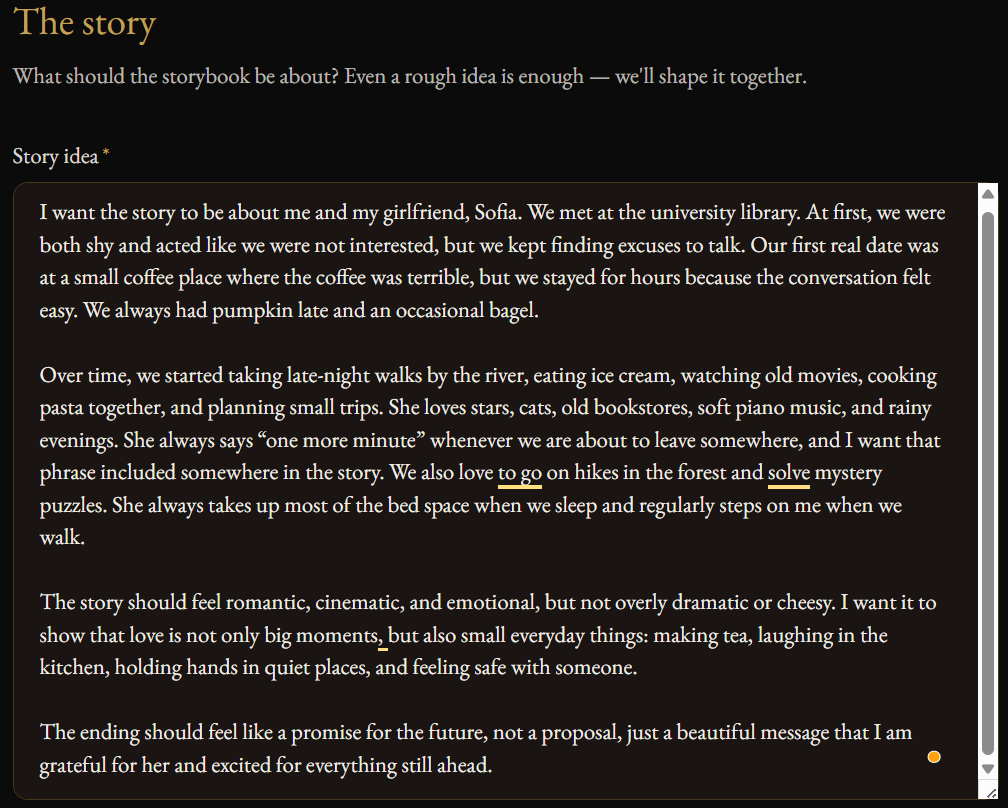
A detailed story idea does not need to be perfectly written. Real memories, phrases, places, habits, and emotional direction help us create a more personal result.
“This is for my girlfriend Mia for our anniversary. I want it to tell the story of how we met, our first awkward date, our trip to Greece, moving into our first apartment with a view of the local park, and how she made my life softer. She loves stars, cats, old movies which I hate but still watch with her, and always says ‘tiny adventure’ whenever we go somewhere. I want the tone to be romantic and emotional, but still playful.”
Want it poetic, funny, or simple?
You can tell us what kind of writing style you prefer. If you want the story to rhyme, feel like a fairytale, read like a letter, feel cinematic, or stay simple and heartfelt, mention that in the notes.
If you are not sure, leave it to us.
“Please make the text rhyme lightly, but not too childish.”
“Make it feel like a fairytale.”
“Keep it simple and emotional, like a letter.”
“Make it playful and funny, with a few inside jokes.”
“Use short poetic lines instead of long paragraphs.”
Simple good vs weak examples
“Make a story for my girlfriend. We have been together for five years.”
“Make a romantic anniversary story for my girlfriend Ana. We have been together for five years. We met through friends at a dinner party where she laughed at me when I spilled my drink, had our first date by the river walking and eating hot dogs, adopted a Garfield-like cat named Milo, and always joke that we are two tired old souls. We love to make pasta together, ride bikes in the forest, and play Monopoly Go with friends. I want it to feel emotional, cozy, and grateful, with an ending about our future.”
“Use these photos.”
“Please use these photos as references for our illustrated versions. Keep her curly hair, my glasses, and the cozy autumn feeling. The photo from the park is important because that is where we had our first serious conversation.”
What are you choosing here?
Here you choose the visual world your story will live in - its atmosphere, colors, typography, page feeling, and emotional mood.
You are not choosing a fixed story. Your memories, photos, names, details, and tone make the Heartfolio personal. The style simply gives those memories a beautiful shape.
You can preview each style before choosing. If you are not sure, choose the one that feels closest to the emotion you want the story to carry.
Ready to start?
Once you have a rough idea, some useful details, and any photos or references you want to use, you are ready. The form will guide you step by step.